Pizza Delivery Process
Understanding the operational logistics behind pizza delivery services.
Kitchen Workflow
The kitchen workflow forms the foundation of successful pizza delivery operations. Efficient kitchen processes ensure that orders are prepared accurately and promptly, which directly impacts delivery times and customer satisfaction. Understanding this workflow helps explain how restaurants manage the complex task of preparing multiple orders simultaneously while maintaining quality standards.
Order Reception and Processing
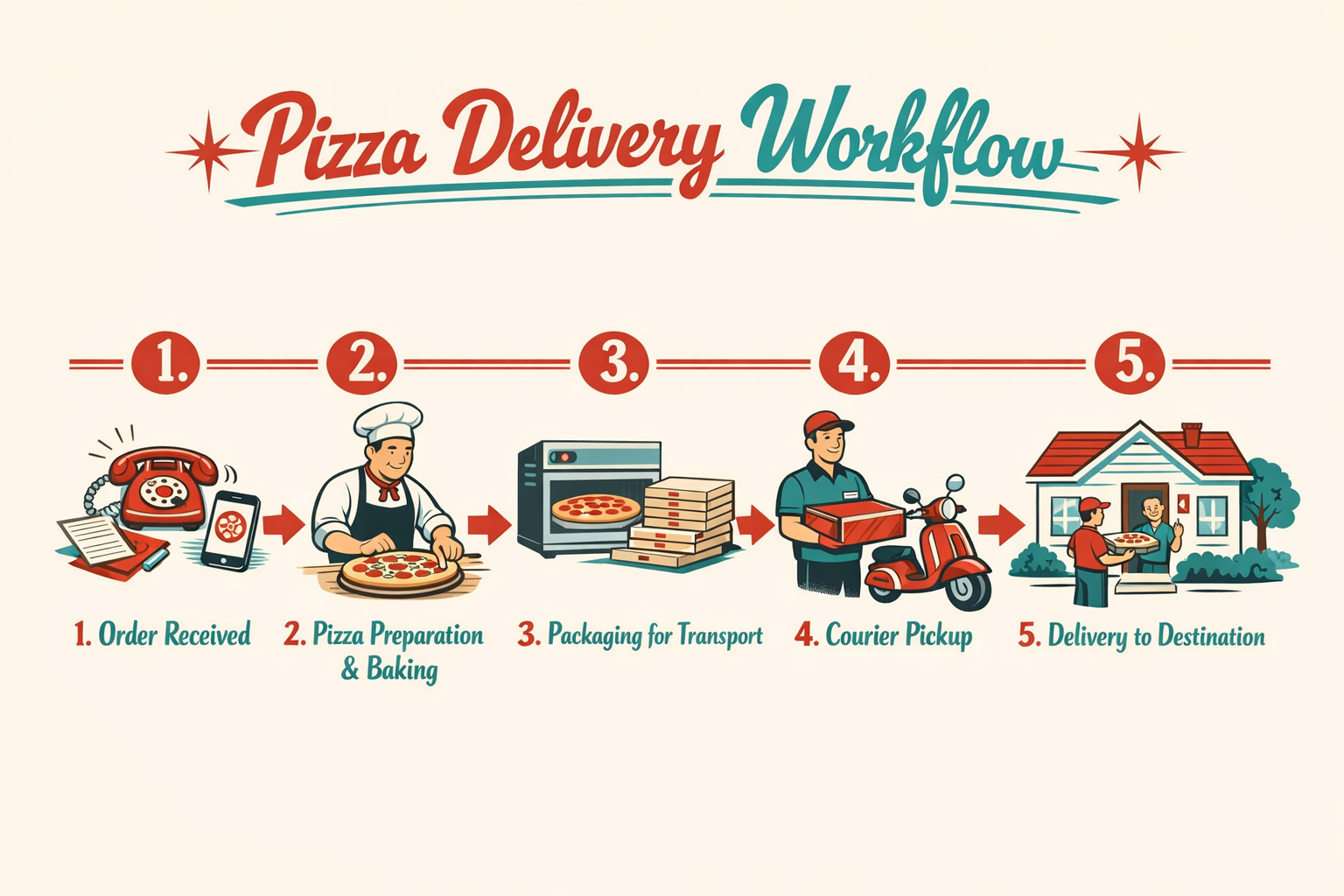
The kitchen workflow begins when an order is received and processed. This initial stage involves recording order details, verifying information, and communicating requirements to the appropriate kitchen staff. Modern pizza restaurants use various systems for order reception, including phone-based systems, online ordering platforms, and mobile applications.
Order processing includes verifying customer information, confirming delivery address, and noting any special instructions or modifications. Accuracy at this stage is crucial, as errors in order processing can lead to incorrect preparations and delivery complications. Many restaurants implement verification procedures to ensure order details are correctly captured and communicated.
Processed orders are typically displayed on kitchen screens or printed tickets for kitchen staff to reference. These order displays include all relevant information needed for preparation, including pizza specifications, quantity, and any special requirements. The organization and clarity of order information contribute significantly to efficient kitchen operations.
Preparation Coordination
Once orders are processed, the preparation phase begins with coordinated efforts across different kitchen stations. Pizza preparation typically involves multiple stations, including dough preparation, topping assembly, and baking. Efficient coordination between these stations is essential for smooth operations and timely order completion.
Dough preparation stations ensure that appropriately sized and shaped pizza bases are available for topping. This stage requires timing and anticipation, as dough must be prepared in advance to meet demand while avoiding over-preparation that could result in waste or quality degradation. Experienced dough preparation staff develop a sense of pacing that matches order flow.
Topping assembly stations apply ingredients according to order specifications. This stage requires both speed and accuracy, as workers must quickly assemble pizzas while ensuring correct topping combinations and quantities. Visual displays of order details help assembly staff reference specifications without constant verbal communication.
Baking stations monitor oven operations and manage the baking process. Modern pizza ovens can accommodate multiple pizzas simultaneously, and experienced oven operators understand how to optimize baking patterns for efficiency. The baking stage represents a critical timing point in the kitchen workflow, as pizzas must be baked correctly and removed at the appropriate moment.
Quality Control and Packaging
Before pizzas leave the kitchen, quality control procedures ensure that orders meet established standards. This final stage of kitchen workflow involves visual inspection, temperature verification, and packaging preparation. Quality control helps prevent mistakes from reaching customers and maintains the restaurant's reputation for consistent quality.
Visual inspection typically checks for proper baking, correct topping application, and overall presentation. Pizzas that don't meet quality standards are corrected or remade before proceeding to packaging. This attention to quality helps ensure customer satisfaction and reduces the likelihood of complaints or returned orders.
Packaging preparation involves assembling appropriate packaging materials and preparing orders for handover to delivery personnel. This stage includes verifying that all items in an order are included, applying any necessary labels or identifiers, and organizing orders for efficient delivery. Proper packaging preparation helps streamline the transition from kitchen to delivery.
Dispatch Coordination
Dispatch coordination represents the critical link between kitchen operations and delivery execution. Effective dispatch ensures that prepared orders reach customers efficiently while optimizing driver utilization and delivery times. This coordination requires real-time communication, decision-making, and organizational skills.
Order-to-Driver Assignment
Assigning orders to appropriate drivers involves considering multiple factors including driver location, current load, route efficiency, and delivery time requirements. Dispatch decisions balance the needs of individual orders with overall operational efficiency, requiring careful judgment and experience.
Driver location considerations include where drivers are relative to both the restaurant and delivery destinations. Drivers who have just completed deliveries and are returning to the restaurant might be assigned new orders, while drivers already on delivery routes might receive additional orders that fit efficiently into their current route.
Current load refers to the number of orders a driver is currently carrying. Dispatch decisions must consider driver capacity to ensure that orders are delivered promptly without overwhelming any individual driver. Balancing driver loads helps maintain consistent delivery times across all orders.
Communication Systems
Effective communication systems are essential for successful dispatch coordination. Modern pizza delivery operations use various communication technologies to maintain real-time contact between restaurants, dispatchers, and drivers. These systems enable efficient information flow and quick decision-making.
Radio communication systems have traditionally been used for delivery dispatch, allowing direct voice communication between dispatchers and drivers. These systems provide immediate communication capabilities and are particularly useful for addressing unexpected situations or providing urgent updates.
Mobile applications and digital dispatch systems represent more modern communication approaches. These systems can provide drivers with delivery information, navigation assistance, and order details directly on mobile devices. Digital systems often include features such as automatic order assignment, route optimization, and real-time status tracking.
Regardless of the specific technology used, effective communication systems ensure that all parties have access to necessary information and can respond quickly to changing conditions. Good communication reduces errors, improves efficiency, and enhances overall delivery performance.
Priority Management
Not all deliveries have the same priority requirements, and effective dispatch coordination includes managing these varying priorities. Factors that might influence delivery priority include order time, customer expectations, special requests, and operational considerations.
Orders that have been waiting longer typically receive higher priority assignment to ensure timely delivery. This first-in, first-out approach helps maintain fairness and consistency in delivery times. However, exceptions may be made for special circumstances or customer requests.
Customer expectations regarding delivery time must be considered in dispatch decisions. When customers have been given specific delivery time estimates, dispatch coordination works to meet those expectations. This might involve prioritizing certain orders or adjusting driver assignments to ensure time commitments are met.
Operational considerations such as route efficiency and driver availability also influence priority decisions. Sometimes grouping orders geographically for efficient delivery takes precedence over strict time-based priority, especially when the time differences are minimal and the efficiency gains are significant.
Delivery Driver Assignment
Delivery drivers are the frontline representatives of pizza delivery services, and their assignment and management significantly impact service quality. Effective driver assignment considers factors such as driver experience, performance history, availability, and current location. Proper driver management helps ensure consistent service quality and operational efficiency.
Driver Experience and Expertise
Driver experience plays an important role in assignment decisions. Experienced drivers typically have developed knowledge of local geography, traffic patterns, and efficient routing strategies. This expertise allows them to complete deliveries more quickly and handle various situations effectively.
Experienced drivers also tend to have established habits and techniques for handling pizzas that help maintain quality during transport. Their familiarity with the delivery process reduces errors and contributes to overall service consistency. Newer drivers may receive different types of assignments or additional supervision as they develop their skills.
Performance history, including on-time delivery rates and customer feedback, also influences driver assignments. Drivers with consistently strong performance records may receive priority assignments or more complex deliveries. Performance-based assignment helps maintain service quality and provides incentives for drivers to perform well.
Availability and Scheduling
Driver availability must be tracked and managed to ensure adequate coverage during peak demand periods. Pizza delivery demand typically follows predictable patterns, with evening hours and weekends being particularly busy. Effective scheduling ensures that sufficient drivers are available during these peak times.
Driver scheduling involves anticipating demand based on historical patterns, day of week, weather conditions, and local events. Experienced dispatchers develop intuition about when demand will be highest and schedule accordingly. This proactive approach helps prevent understaffing during busy periods.
Real-time availability management also occurs as drivers complete deliveries and become available for new assignments. Dispatch coordination must balance immediate needs with longer-term scheduling considerations to maintain optimal driver utilization throughout service hours.
Location and Route Considerations
Driver location at any given time affects assignment decisions. Drivers returning to the restaurant from previous deliveries are available for new assignments, while drivers currently on routes might receive additional orders that fit efficiently into their current path. This dynamic assignment approach maximizes efficiency and reduces unnecessary travel.
Route considerations include grouping orders geographically to minimize total travel distance and time. Drivers assigned to specific areas or routes may receive multiple orders within that area before returning to the restaurant. This approach reduces empty travel and improves overall delivery efficiency.
Sometimes drivers are assigned to specific territories or zones, particularly in areas with well-defined delivery boundaries. This zone-based assignment can simplify dispatch coordination and help drivers develop detailed knowledge of their assigned areas. However, flexible assignment approaches that respond to real-time conditions often prove more efficient overall.
Route Planning
Effective route planning is essential for timely delivery and operational efficiency. Drivers must navigate to multiple destinations while considering traffic patterns, road conditions, and delivery priorities. Good route planning minimizes travel time, reduces fuel consumption, and helps ensure pizzas arrive in optimal condition.
Navigation Technology
Modern navigation technology has transformed route planning for delivery drivers. GPS systems and mapping applications provide real-time traffic information, optimal routing suggestions, and turn-by-turn directions. These tools help drivers navigate unfamiliar areas efficiently and adapt to changing conditions.
Navigation applications can account for current traffic conditions and suggest alternative routes when congestion is detected. This real-time adjustment capability helps drivers avoid delays and maintain delivery schedules. The ability to respond to traffic conditions dynamically represents a significant improvement over static route planning approaches.
Beyond basic navigation, advanced systems can integrate multiple delivery stops into optimized routes. These systems consider factors such as delivery time windows, geographic clustering, and efficient sequencing of stops. The result is routes that minimize total travel time while meeting all delivery requirements.
Traffic Pattern Awareness
Understanding traffic patterns is crucial for effective route planning. Experienced drivers develop knowledge of when and where congestion typically occurs, allowing them to plan routes that avoid problem areas. This awareness helps maintain consistent delivery times despite varying traffic conditions.
Rush hour periods, typically morning and evening commute times, present particular challenges for delivery drivers. Planning routes that avoid major arterial roads during these periods can significantly reduce travel time. Similarly, awareness of local traffic patterns around schools, shopping centers, and other destinations that generate congestion helps drivers plan more efficiently.
Special events such as sporting events, concerts, or road construction can create unusual traffic conditions that require route adjustments. Drivers and dispatchers must stay informed about such events and plan accordingly to avoid delays that could affect delivery times.
Delivery Sequencing
The sequence in which deliveries are made affects both efficiency and pizza quality. Drivers must consider factors such as delivery time commitments, pizza sensitivity to transport time, and geographic efficiency when sequencing deliveries. Proper sequencing helps ensure all customers receive their orders in optimal condition.
Time-sensitive deliveries should typically be made earlier in the route to meet delivery commitments. Similarly, orders that are more susceptible to quality degradation during transport might be prioritized. This consideration of pizza quality alongside geographic efficiency represents an important aspect of delivery sequencing.
Geographic clustering helps reduce total travel distance and time. Grouping deliveries in the same general area together minimizes backtracking and improves overall efficiency. However, geographic efficiency must be balanced against time commitments and quality considerations to achieve optimal results.
Important Information
Please Note: This website provides educational information about pizza delivery operational logistics. We do not provide pizza delivery services, employ delivery drivers, or facilitate any food-related transactions. This information is presented for general educational purposes only.