Understanding Pizza Delivery Services in the United States
This website provides general information about how pizza delivery systems operate, including delivery logistics, service areas, and timing expectations.

Introduction to Pizza Delivery
Pizza delivery represents one of the most popular and convenient methods of restaurant food service in the United States. The concept involves restaurants preparing pizzas and transporting them directly to customers' locations, typically homes or offices. This service model has evolved significantly over the decades, adapting to changing consumer preferences and technological advancements.
Historically, pizza delivery began with traditional phone orders, where customers would call restaurants directly to place their orders. This method required customers to speak with restaurant staff, describe their desired pizzas, and provide delivery information verbally. While effective, this approach relied heavily on accurate communication during the phone call and manual order processing by restaurant employees.
The growth of digital ordering systems has transformed the pizza delivery landscape. Modern platforms allow customers to browse menus, customize pizzas, and place orders through websites or mobile applications. This technological shift has increased ordering accuracy, reduced communication errors, and provided customers with greater control over their order details. Digital systems also enable restaurants to track orders more efficiently and manage their delivery operations more effectively.
Delivery services have experienced particularly rapid growth in urban areas, where population density and busy lifestyles create high demand for convenient food delivery options. Major cities across the United States feature extensive pizza delivery networks, with numerous restaurants competing to serve local neighborhoods. The convenience factor has made pizza delivery a staple of urban dining culture, with many households relying on it regularly for meals.
The Evolution of Delivery Methods
The pizza delivery industry has continuously evolved to meet changing customer expectations and technological possibilities. What began as a simple phone-based service has developed into a sophisticated system involving digital platforms, real-time tracking, and optimized logistics. This evolution reflects broader trends in the restaurant industry and consumer behavior.
Early pizza delivery relied heavily on telephone communication and paper-based order management. Restaurant staff would write down orders, manually calculate totals, and communicate delivery information to drivers. This system, while functional, was prone to errors and inefficiencies that could affect customer satisfaction.
The introduction of computerized point-of-sale systems in the 1980s and 1990s marked a significant improvement in order management. These systems allowed restaurants to process orders more quickly and accurately, track inventory, and maintain customer records. However, the fundamental delivery model remained largely unchanged, with customers still placing orders primarily through phone calls.
The internet revolution of the early 2000s brought online ordering capabilities to many pizza restaurants. Customers could now place orders through websites, often with visual menu representations and customization options. This development improved the ordering experience and reduced errors associated with verbal communication. Online ordering also enabled restaurants to collect valuable data about customer preferences and ordering patterns.
Mobile applications have further enhanced the pizza delivery experience in recent years. Smartphone apps provide customers with convenient ordering interfaces, push notifications about order status, and real-time delivery tracking. These features have increased transparency and convenience, making pizza delivery more accessible and user-friendly than ever before.
General Delivery Workflow
Understanding the typical pizza delivery workflow helps explain how these services operate efficiently. The process involves several coordinated steps that must execute smoothly to ensure timely and accurate delivery. Each stage of the workflow presents unique challenges and requires careful management by restaurant staff and delivery personnel.
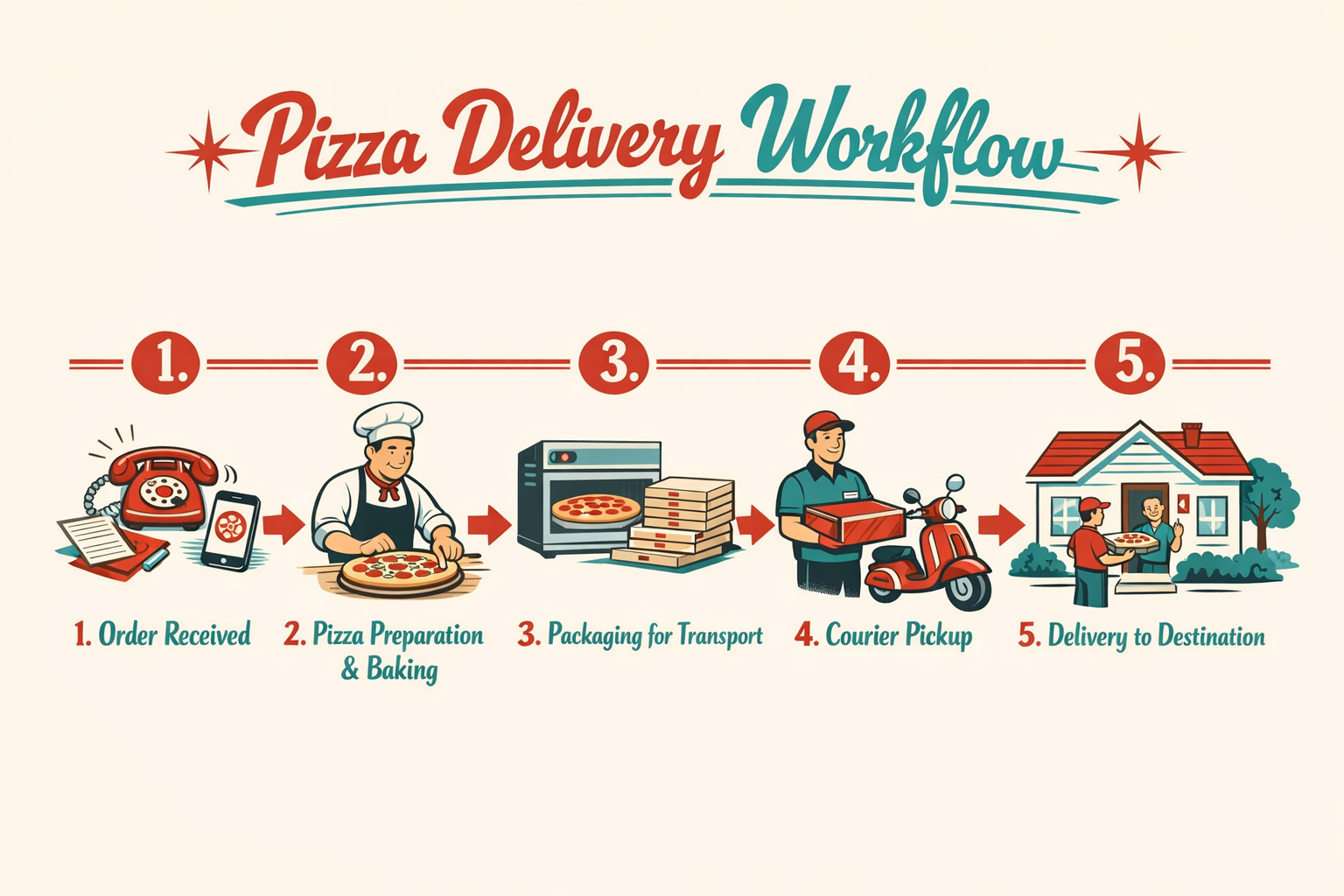
Order Received
Restaurant receives order through phone, website, or app
Preparation
Pizza prepared, baked, and quality-checked
Packaging
Pizza boxed and prepared for transport
Pickup
Driver collects order and receives delivery details
Delivery
Order transported and delivered to customer
This workflow demonstrates the coordination required between kitchen staff and delivery drivers. The kitchen team must prepare orders quickly while maintaining quality standards, while drivers must navigate routes efficiently to ensure timely delivery. Effective communication between these groups is essential for smooth operations.
Delivery Areas
Pizza delivery services typically operate within defined geographic areas around each restaurant location. These delivery zones are established based on various factors including practical logistics, cost considerations, and service quality requirements. Understanding how delivery areas are determined helps explain why not all locations can receive delivery service from every restaurant.
Service radius limitations represent the most common method for defining delivery areas. Restaurants establish a maximum distance from their location, often measured in miles or driving time, beyond which they will not deliver. This radius ensures that delivery times remain reasonable and that food quality can be maintained during transport. Typical delivery radii range from 3 to 7 miles, depending on the restaurant's capabilities and local conditions.
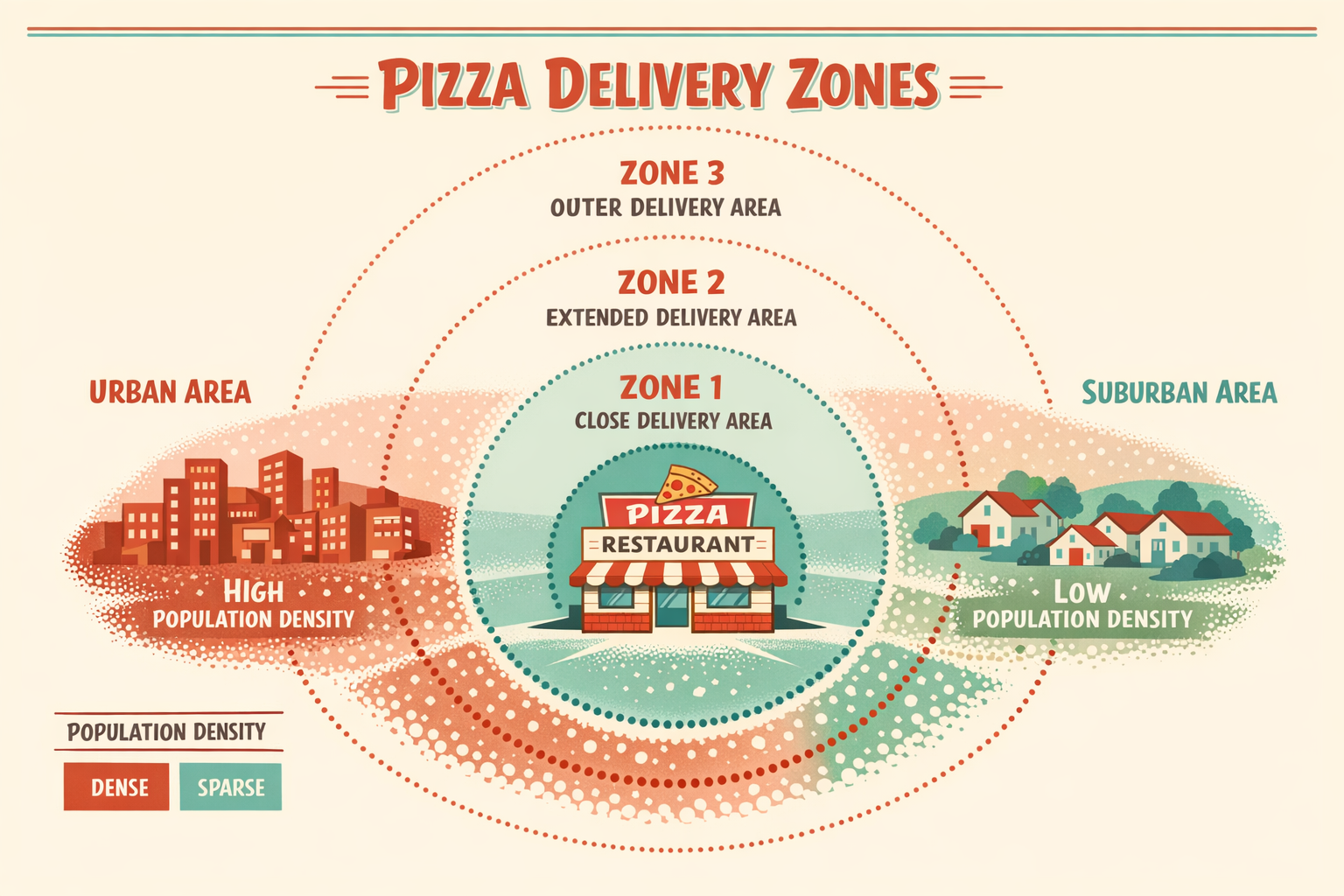
Urban vs Suburban Delivery Zones
Delivery areas often differ significantly between urban and suburban environments due to varying conditions. In dense urban areas, restaurants may serve smaller geographic areas but higher volumes of orders due to population concentration. The shorter distances in urban environments allow for faster delivery times and more efficient route planning, despite potential traffic congestion.
Suburban delivery zones typically cover larger geographic areas to serve dispersed populations. While individual deliveries may travel longer distances, the lower population density means fewer orders per unit area. Restaurants in suburban locations must balance the desire for wide coverage with the practical limitations of travel time and driver availability.
The density of development also affects delivery feasibility. Areas with many apartment buildings or multi-unit dwellings may be more attractive for delivery services because multiple orders can be delivered to the same general location. Conversely, areas with widely spaced single-family homes may be less efficient to serve, potentially affecting delivery area boundaries.
Restaurant Location Importance
The physical location of a restaurant significantly influences its delivery capabilities. Restaurants situated in central, accessible locations can often serve larger areas than those in peripheral locations. Proximity to major roads and highways enhances delivery efficiency by reducing travel time between the restaurant and customer locations.
Restaurants located in commercial areas may face different delivery considerations than those in residential neighborhoods. Commercial area restaurants might focus on delivering to nearby businesses during lunch hours, while residential location restaurants typically experience peak demand during dinner hours. These patterns affect how delivery areas are configured and when delivery services are available.
The competitive landscape also influences delivery area decisions. In areas with many pizza restaurants, each establishment must define its delivery zone carefully to avoid excessive overlap with competitors. This may result in smaller, more focused delivery areas in highly competitive markets compared to areas with fewer options.
Informational Purpose
Important Notice: This website exists solely to provide educational information about how pizza delivery systems operate. We do not offer food ordering, payment processing, or delivery services of any kind.
This website serves as an informational resource designed to help people understand the logistics and operations behind pizza delivery services in the United States. The content presented here is educational in nature and aims to explain general concepts about delivery systems, service coverage, timing factors, and related topics.
Our goal is to provide clear, accurate information about how pizza delivery works from an operational perspective. We cover topics such as order processing workflows, delivery area determination methods, factors affecting delivery times, and the evolution of delivery technologies. This information is intended for general educational purposes and does not endorse or promote any specific pizza delivery companies or services.
It is important to understand that this website is purely informational and does not facilitate any commercial transactions. We do not connect users with pizza restaurants, process orders, handle payments, or coordinate deliveries. Visitors seeking to order pizza for delivery should use established ordering platforms or contact pizza restaurants directly.
The information provided here is based on general knowledge about pizza delivery operations and is not affiliated with any specific delivery services, restaurant chains, or ordering platforms. We strive to maintain accuracy in our content but acknowledge that specific operational practices may vary between different restaurants and delivery companies.